The Emerging Agent Discovery Stack
AI agent discovery has not settled on one protocol; experiments are revealing a layered stack of DNS bootstrap, trust, registries, manifests, overlays, governance, and commerce.
The Emerging Agent Discovery Stack
Imagine a client is asked to interact with the support agent for acme.com.
First, the client needs a low-friction starting point: "where should I go, and which protocol should I speak?" A DNS-first mechanism such as AID can answer that with a compact record at _agent.acme.com, while other proposals use richer DNS namespaces, SVCB records, or protocol-specific labels such as _mcp.acme.com.
Second, the client needs description: what can the agent do, which skills or tools does it expose, what authentication does it require, and how should a client invoke it? That information usually belongs in an agent card, manifest, registry entry, or /.well-known document rather than in DNS.
Third, the client needs trust and authorization. DNS control can help anchor a claim, but it does not by itself prove legal authority, delegated permission, or runtime safety. Endpoint proof, domain validation, OAuth-style delegation, workload identity, enterprise governance, and audit all become separate questions.
Fourth, if the task involves money, the client needs a commerce layer: product or service discovery, user intent, payment authorization, settlement, receipts, dispute evidence, and network risk signals. That is where x402, Stripe/OpenAI's Agentic Commerce Protocol, Google's AP2, Google's UCP, Machine Payments Protocol, ERC-8183, and card-network trust efforts enter the picture. They sit above discovery because they depend on finding and trusting the right parties first.
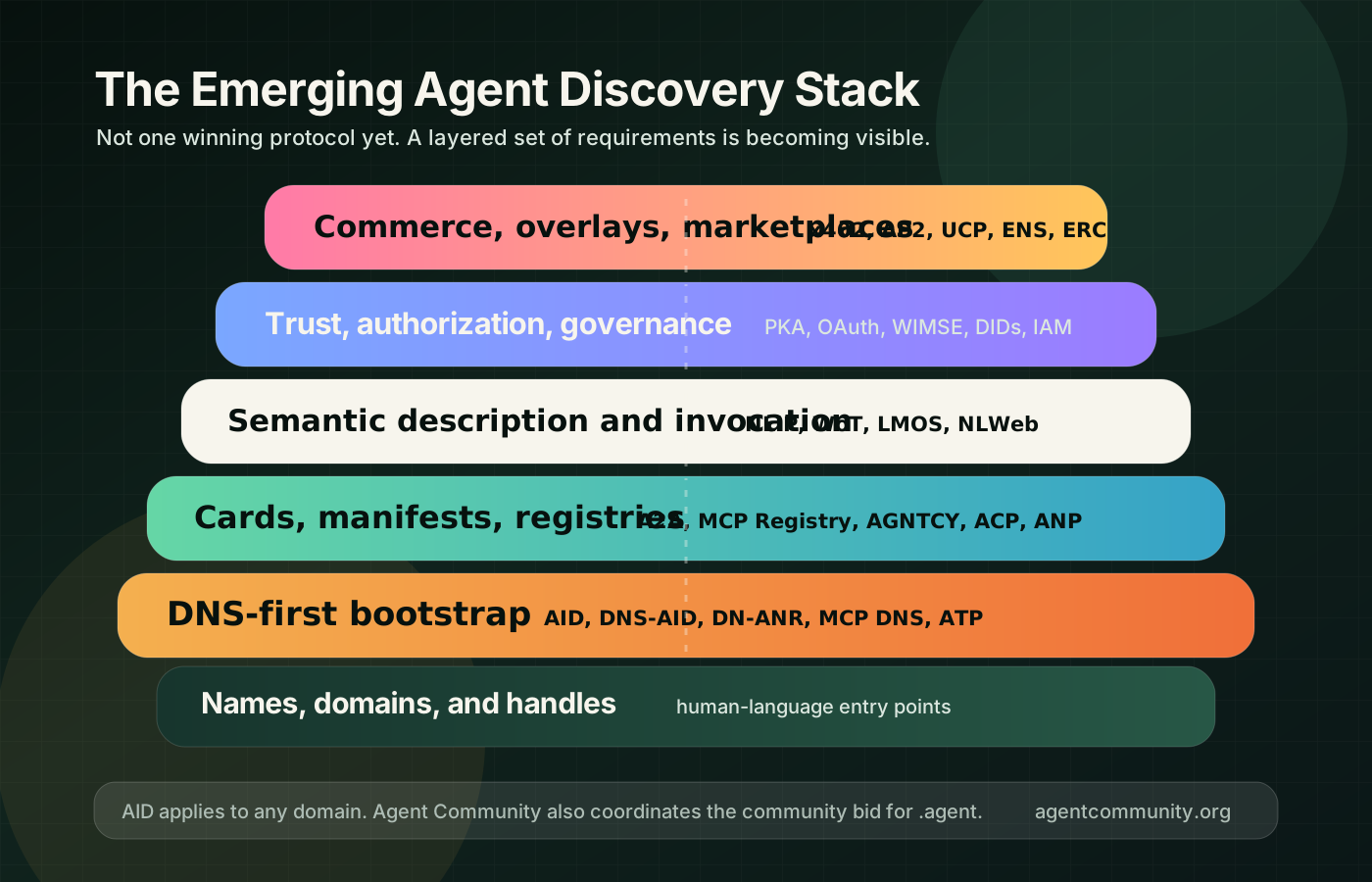
That staged model is the core of the current landscape. A domain or handle gets the client started; a card, manifest, or registry explains the agent; a trust layer verifies who stands behind it; an authorization layer constrains what it may do; and domain-specific surfaces such as marketplaces or commerce networks add ranking, policy, consent, payment, and transaction guarantees.
If the agentic web becomes more than a product metaphor, agents will need to be named, found, described, and trusted across organizational boundaries. That sounds like one problem, but it is really several. "Finding an agent" can mean resolving a stable identifier, locating an endpoint, retrieving machine-readable metadata, verifying who stands behind that endpoint, and deciding whether the agent is authorized to act in context.
As of April 24, 2026, agent discovery has not settled on one protocol. The more interesting signal is that experimentation is making the requirements clearer. Different approaches overlap, sometimes awkwardly, but the overlap is revealing the stack: bootstrap, description, trust, authorization, registries, overlays, governance, and commerce are separating into different responsibilities.
This piece is published by Agent Community, which maintains AID. AID is listed first where it is directly relevant.
Agent Community is also organizing the community bid for the .agent TLD as a naming layer for the agentic web. That context matters to us, but AID is designed for any domain and the broader stack discussed here applies far beyond .agent.
Why This Is Happening Now
Agent discovery sits between two eras of internet infrastructure.
The first era gave us durable identity and metadata building blocks: SAML metadata, WebFinger, OIDC and OAuth discovery, SCIM, OpenID Federation, ACME, DNSSEC, DANE/TLSA, transparency logs, and workload identity patterns. Identity-literate readers will recognize the inheritance: names, issuers, metadata, keys, policy, provisioning, and trust chains.
The agent wave adds a different pressure. Software actors now need to be discoverable as task-performing endpoints across organizational boundaries. They may expose protocols such as MCP or A2A, carry machine-readable capability descriptions, prove endpoint authenticity, receive delegated authority from a user or organization, appear in registries or marketplaces, and participate in commerce flows.
That is why the field does not look like one clean protocol lineage. It is a newer stack forming on top of an older substrate. Most of the artifacts in this map are not finished standards: many are active individual Internet-Drafts, ecosystem drafts, previews, product surfaces, or discussion threads. That does not make them unimportant. It means the useful question is less "which one won?" and more "which responsibility is each effort trying to own?"
The Stack at a Glance
The cleanest way to read the landscape right now is by responsibility, not by logo or standards body.
| Layer | Primary job | Current evidence status | Representative efforts |
|---|---|---|---|
| Cross-protocol DNS-first bootstrap | Turn a domain into an initial agent endpoint or protocol hint | Agent Community spec plus active individual Internet-Drafts | AID, AID I-D, DNS-AID, DN-ANR |
| Protocol-specific bootstrap | Help one protocol family resolve quickly from a domain | Active individual Internet-Drafts plus deployed precedent from adjacent systems | MCP DNS Discovery, Serra MCP discovery, ATP, AT Protocol handles as precedent |
| DNS-anchored trust and identity | Prove endpoint control, domain control, or domain-linked identity claims | Agent Community mechanism, active individual Internet-Drafts, DID methods, and implementation activity | AID PKA, ANSv2, ApertoID, Agent Identity Registry, did:dns, did:web |
| Registry, manifest, and HTTP discovery | Carry rich metadata, capability description, search, and invocation detail | Released ecosystem specs, official ecosystem previews, open-source schema systems, and active individual Internet-Drafts | A2A Agent Card, MCP Registry, MCP Server Cards, AGNTCY ADS, OASF, ACP Agent Manifest, ANP discovery, NLWeb, AINS |
| Agent communication and semantic description | Describe agent interactions, payloads, affordances, and machine-readable capability surfaces | Published standards, W3C precedents, and ecosystem specifications | ECMA NLIP, W3C WoT Discovery, WoT Thing Description 2.0, Eclipse LMOS, Agent Communication Protocol, ANP Agent Description |
| On-chain and ENS overlays | Add portable identifiers, registry pointers, reputation, or cross-ecosystem bridges | EIPs, ENS proposals or discussions, and ecosystem standards | ENSIP-25, ENSIP-26 discussion, ERC-8004, HCS-14 |
| Identity, delegation, and governance frameworks | Represent agents as principals with scoped authority, audit, lifecycle control, and policy | Active individual Internet-Drafts, IETF/OAuth work, NIST activity, and enterprise product surfaces | AIP, AI-Agent Auth, OAuth Protected Resource Metadata, OAuth Identity Chaining, NIST AI Agent Standards Initiative, Microsoft Entra Agent ID |
| Commerce and platform trust | Connect discovery to consent, transaction routing, payment authorization, settlement, and network-level trust | Launched product surfaces, public protocol docs, draft EIPs, and active deployment programs | OpenAI instant checkout / Agentic Commerce Protocol, OpenAI product discovery in ChatGPT, Stripe Agentic Commerce Protocol, Stripe x402, Google AP2, Google UCP, MPP, ERC-8183, Visa Trusted Agent Protocol |
The point of this table is not to imply clean boundaries. Many efforts span more than one layer. The value is that the field becomes easier to reason about once routing, description, trust, authorization, overlays, and commerce are no longer forced into the same bucket.
These approaches are not all substitutes. They are often complements: DNS-first bootstrap gets a client started, cards and registries explain what an agent can do, trust layers establish who stands behind the endpoint, and commerce layers add payment and transaction semantics.
DNS as the Broader First Hop
Across multiple public proposals, DNS-first agent bootstrap has become a visible pattern. AID, DNS-AID, and DN-ANR all treat DNS as a primary starting point, even though they make different design choices.
The disagreement is not really "DNS or no DNS." It is how much meaning DNS should carry.
AID takes the minimalist view. A TXT record at _agent.<domain> provides a compact bootstrap: protocol token, endpoint URI, authentication hint, optional metadata, and optional public-key material. The design intentionally keeps large capability descriptions out of DNS. AID is an Agent Community final specification with a related individual Informational Internet-Draft, draft-nemethi-aid-agent-identity-discovery. It should not be described as an IETF standard.
AID's limitation is also its point. It does not try to be a registry, ranking engine, marketplace, delegation framework, or full authorization system. It answers a narrower question: given this domain, where is the agent entry point and which protocol should a client try next?
That said, AID is not purely "discovery only." Its optional PKA mechanism adds endpoint proof. When the pka field is present, the discovered endpoint proves control of a DNS-published Ed25519 key through an RFC 9421 HTTP Message Signatures handshake. That proves control of the key published for that endpoint. It does not by itself prove legal authority, organizational delegation, or business reputation.
DNS-AID is structurally richer. It uses a namespace under _agents.<domain> and leans into SVCB-based service binding, metadata exchange, and capability advertisement. DN-ANR sits closer to DNS-native naming and resolution: it uses SVCB and optional TXT or DNSSEC-backed integrity material, but is better described as resolving selected agent identifiers than as doing semantic discovery or ranking.
That design split matters. A thinner DNS layer is easier to operate and less likely to duplicate constantly changing metadata. A richer DNS layer can reduce fetches and make the first hop more expressive. The field has not settled that tradeoff.
What is striking is that protocol-specific communities keep rediscovering the same pattern. MCP DNS Discovery uses _mcp.<domain> TXT records for MCP server bootstrap and, in its newer drafts, also introduces an organizational identity bootstrap record. Serra's MCP discovery work combines a mcp:// URI, /.well-known/mcp-server, and optional DNS acceleration. ATP uses _atp.<domain> SVCB but is broader than bootstrap alone, covering agent transport, identity, authentication, messaging, and capability exchange. AgentDNS, now expired, is still useful as evidence that DNS-inspired namespace and service-discovery designs were already being explored before the current wave of drafts. Even the older AT Protocol handle system, while not an AI-agent standard, is a useful precedent for DNS-backed name resolution with HTTPS fallback and bidirectional validation.
Not every first-hop proposal is DNS-native. The active agent:// URI scheme draft tries to create a transport-agnostic addressing layer that can resolve toward descriptors and then delegate communication to protocols such as A2A, MCP, or Agent Communication Protocol. That belongs near bootstrap, but it is a different design move: instead of asking "which DNS label should a client query?", it asks whether agents need their own URI shape at all.
In other words, DNS may or may not become the universal agent-discovery layer. But it remains unusually well-positioned as a first-hop substrate because it is already distributed, operator-controlled, globally deployed, and part of the path to almost every HTTPS service.
One easy way to understate DNS is to treat it as merely a pointer to /.well-known documents. It can do that, but that is not the core advantage.
DNS sits below the web application layer. A domain can publish a DNS record even when there is no web server, no application route, and no /.well-known endpoint. That makes DNS a broader first-hop substrate for agents that may live behind HTTP, WebSocket, gRPC, custom transports, registries, message queues, local networks, enterprise systems, or future protocols that are not naturally represented as an HTTPS origin document.
/.well-known remains valuable, but it is narrower. RFC 8615 reserves the /.well-known/ path prefix for origin-wide metadata. In agent discovery, that pattern shows up in places such as A2A's /.well-known/agent-card.json, MCP server-card work, ACP's /.well-known/agent.yml, ANP's /.well-known/agent-descriptions, OAuth Protected Resource Metadata, DID Configuration, and AI Discovery Endpoint. All of those assume there is an origin capable of serving the relevant HTTP resource.
The practical distinction is important. DNS can point to a /.well-known document, but it does not have to. It can point directly to an endpoint, registry, protocol URI, service binding, or key material. It can also tell the client which protocol family to try before the client commits to HTTP at all.
That does not mean DNS should carry every detail. Large capability graphs, frequently changing skill metadata, pricing rules, policy text, and invocation schemas usually belong in cards, manifests, registries, or HTTP documents. The stronger claim is narrower: DNS is technically more general as a first-hop discovery substrate, while /.well-known is a useful HTTP-origin metadata pattern above it.
Trust Is Separating from Routing
Once agents represent organizations, spend money, or trigger actions on behalf of others, "where is the endpoint?" stops being enough. The next questions are sharper: who controls the namespace, who controls the endpoint key, who authorized the agent to act, what scope was delegated, and how can the action be audited later?
Those are related identity questions, but they are not the same question.
| Question | Typical layer | Examples |
|---|---|---|
| Does this domain publish an agent entry point? | Bootstrap | AID, DNS-AID, DN-ANR |
| Does this endpoint control the key advertised for it? | Endpoint proof | AID PKA, message signatures, mTLS-style proof of possession |
| Does this domain or organization authorize the agent? | Domain or organization trust | ANSv2, ApertoID, Agent Identity Registry, DID domain linkage |
| What may the agent do for this user or organization? | Authorization and delegation | OAuth, token exchange, scoped credentials, enterprise IAM |
| Can the agent be governed over time? | Lifecycle and audit | Entra Agent ID, Okta AI Agents, WorkOS credential patterns, transparency logs |
The practical consequence is simple: discovery can tell a client where to go, but authorization decides whether this agent may act for this user, against this resource, under these constraints, at this moment. That is why endpoint proof, domain control, delegated authority, runtime attestation, and audit trail keep showing up as adjacent but distinct concerns.
AID PKA belongs at the narrower end of this trust lane: it proves that the discovered endpoint controls a private key corresponding to public material in DNS. ANSv2 is broader and more trust-centered: ACME-based domain validation, server and identity certificates, transparency logging aligned with SCITT concepts, verification tiers, and domain-anchored lifecycle signals. Discovery is present, but identity and lifecycle control are the center of gravity. The GoDaddy ANS Registration Authority matters because it shows a public implementation path for ANS-style registration authority behavior, not because ANSv2 is a completed standard.
ApertoID makes a similar move in a different form. It publishes DNS declarations under _apertoid.<domain> and references a companion request-signing mechanism. It is less about search and more about authorized declarations, policy, delegation, and proof of control. Agent Identity Registry also belongs here, but it should not be reduced to DNS anchoring. Hardware attestation, federated registrars, public lookup, and governance are central; DNS TXT and SRV are bootstrap pieces inside a broader identity registry proposal.
The same design space appears in DID-adjacent work. did:dns uses DNS records as a DID resolution substrate. did:web binds a DID document to an HTTPS origin. did:webvh adds verifiable history to the did:web style of resolution. DID Configuration links DIDs to web domains through a well-known resource and domain-linkage assertions. High-Assurance DIDs with DNS explores DNS-based cross-validation. These are not agent-discovery standards, but identity readers will recognize them as part of the same domain-control and key-binding conversation.
Adjacent identity work is also relevant even when it is not agent-specific. OAuth Token Exchange gives a vocabulary for delegation and impersonation, while OAuth Identity and Authorization Chaining is closer to the cross-domain chain-of-calls problem that appears when one agent invokes another service on a user's behalf. OAuth Protected Resource Metadata is especially important because it lets a protected API publish how it is protected and where authorization metadata lives; for agent clients, that becomes part of discovering not just "where is the tool?" but "how do I get a usable token for it?" OAuth Dynamic Client Registration and the active OAuth Client ID Metadata Document matter for the same reason: open agent ecosystems cannot assume every client was manually pre-registered.
DPoP, OAuth mTLS, OAuth Resource Indicators, and OAuth Rich Authorization Requests are not agent-discovery protocols, but they provide vocabulary for proof of possession, target-resource binding, and structured authorization details. SPIFFE and the IETF WIMSE working group are part of the workload-identity lineage, with concrete work on workload identifiers and workload credentials. RATS and Entity Attestation Tokens sit nearby when the question becomes "what runtime, device, or software environment is this agent actually running in?"
Web Bot Auth is adjacent because it addresses authenticated automated clients on the web. OpenID Shared Signals is adjacent because agent trust will likely need continuous signals for suspension, compromise, revocation, and remediation rather than one-time authentication. The W3C Verifiable Credentials Data Model 2.0 and related Data Integrity work are also relevant because organization-issued agent credentials, delegation attestations, and capability claims need portable formats if they are to move across registries.
Nearby agent-specific frameworks such as AIP, SAIP, VAIP, and AI-Agent Auth push further into delegation, audit, permission scope, workload identity, and trust scoring. NIST's AI Agent Standards Initiative and NCCoE Software and AI Agent Identity and Authorization project are not protocols, but they are strong evidence that identity, authorization, and interoperability are becoming standards-track concerns. They reinforce the broader point: routing and attestation are being designed together without being the same layer.
Rich Discovery Is Moving Toward Registries and Manifests
If DNS is strongest as a low-friction first hop, the mirror image is also becoming clear: rich discovery keeps moving toward registries, manifests, cards, and HTTP metadata documents.
That shift is visible in AINS, AIDIP, ARDP, AI Discovery Endpoint, and AGTP discovery. The common intuition is that capability detail, richer policy, search, ranking, and invocation metadata belong in JSON documents or registries, not in compact DNS records.
A2A is the clearest released, vendor-backed specification example of that logic. The /.well-known/agent-card.json document acts as a durable description surface for an A2A agent's capabilities, endpoints, authentication requirements, and skills. Broader discovery can happen through direct configuration, curated registries, marketplaces, or catalogs.
MCP now has its own registry and card story as well. The MCP Registry is currently in preview and provides an official centralized metadata repository for publicly accessible MCP servers, with server.json metadata, namespace authentication, and a REST API for aggregators. The MCP Server Card Working Group is working on a standardized MCP Server Card and discovery mechanism, and the MCP roadmap explicitly lists server cards as a standard for exposing structured server metadata through a .well-known URL.
AINS is worth reading as more than just registry discovery. It combines HTTPS resolution, rich metadata, trust evidence, and signed append-only federation logs. AIDIP emphasizes RESTful discovery and invocation with capability-oriented metadata. ARDP defines a registration and resolution control plane with identifiers, capabilities, presence, and federation. AI Discovery Endpoint proposes a /.well-known/ai document for machine-readable service description. AGTP discovery uses an agent name service and ranked Agent Manifest Documents.
One registry-layer effort worth calling out separately is AGNTCY Agent Directory Service. ADS is a distributed directory proposal for agent records, content addressing, DHT-style lookup, provenance, and capability-based search. It is tightly connected to the Open Agentic Schema Framework, which defines structured records for agent capabilities, interactions, metadata, skills, domains, and modules. That is a different emphasis from AID or DNS-AID: not "how do I get from a domain to a starting endpoint?", but "how do I search and validate a population of agent records?"
There is also an important acronym trap. In commerce, ACP usually means Stripe/OpenAI's Agentic Commerce Protocol. In interoperability discussions, ACP often means the Linux Foundation/BeeAI Agent Communication Protocol. The latter defines an Agent Manifest with identity, capabilities, metadata, runtime status, supported content types, and cataloging fields. Its discovery docs describe direct server queries, public /.well-known/agent.yml manifests, registries, and embedded discovery, while noting that open discovery is not yet part of the official ACP core spec.
ANP approaches the same terrain from a linked-data direction. Its discovery draft uses JSON-LD and /.well-known/agent-descriptions to publish collections of agent description documents, while the broader Agent Network Protocol work leans on DIDs and schema.org-style metadata. NLWeb is not a general agent registry, but it is relevant because it turns websites into structured natural-language endpoints with HTTP, MCP, and A2A-style action bindings. ECMA NLIP is also not discovery-first, but it is a real standards-body protocol for natural-language interaction between AI agents or between humans and agents.
Finally, W3C and Eclipse work are useful precedents for description rather than direct competitors. W3C WoT Discovery already standardizes ways to obtain machine-readable Thing Descriptions through well-known URIs, directories, DNS-SD, DID documents, and local or global discovery flows. WoT Thing Description 2.0 is active draft work on describing affordances, forms, protocols, data schemas, and security metadata. Eclipse LMOS adapts similar ideas to agents and tools, including agent descriptions, local/global discovery, registries, DIDs, and metadata propagation.
The contrast with DNS is the useful part. A card or registry can say: this agent handles refunds, exposes these skills, requires these scopes, accepts these content types, prefers this invocation protocol, and publishes this policy metadata. That is exactly the kind of information that should not be squeezed into a compact first-hop record.
The likely lesson is not DNS versus registries. It is staged discovery. DNS answers "where do I start?" A card or manifest answers "what can this agent do?" A trust layer answers "who stands behind this endpoint?" Authorization answers "what may it do in this context?"
On-Chain and ENS as Compositional Overlays
Crypto and on-chain work should be visible in this conversation, but it should not dominate the core architecture. Most of the strongest public efforts in that lane are better understood as overlays, bridges, or portable identifier systems.
ENSIP-25 is a useful example. It connects ENS names to agent registries through ENS text records. That matters if public agents need portable naming and discoverable registry references, but it is not the same as open-web DNS bootstrap. ENSIP-26-style metadata discussions are worth watching too, though they remain fluid enough to describe cautiously.
ERC-8004 is another important case. It is best framed as draft on-chain identity, reputation, and validation registry work, not a DNS-native discovery protocol. Its relevance comes from composability: an on-chain agent record can point to DNS, ENS, DID, A2A, MCP, or other surfaces without replacing them.
HCS-14 is especially interesting because it behaves like a meta-identifier framework. Its profile registry includes AID DNS/Web and _uaid DNS TXT resolution profiles. In that sense, it looks less like a direct competitor to every naming proposal and more like an attempt to coordinate across them. By contrast, HCS-18 and HCS-21 are better treated, at least for now, as draft ecosystem infrastructure rather than mature open discovery standards.
The broader point is simple: on-chain and ENS systems matter most when they compose with the web stack, not when they are assumed to replace it. They can help with portability, registry linkage, and reputation continuity, but they are not the natural low-latency first hop for a client starting from a bare web domain.
Commerce Is Becoming the Layer Above Discovery
Commerce is not agent discovery, but it is one of the clearest reasons discovery has to become more precise. Once an agent can find a merchant, paid API, service provider, or other agent, the next questions become transactional: what is being bought, who authorized it, how is payment requested, what evidence travels with the transaction, and who is accountable if something goes wrong?
That is why commerce protocols sit above the discovery and identity stack rather than replacing it. x402 revives HTTP 402-style payment challenges for machine payments. Stripe/OpenAI's Agentic Commerce Protocol focuses on checkout and order handoff. Google's Agent Payments Protocol frames payments around verifiable digital credentials and payment mandates, extending A2A and MCP-oriented flows. Google's Universal Commerce Protocol is broader: it tries to create a common commerce language for agents, apps, businesses, and payment providers. MPP aims at per-request machine-to-machine payments for APIs, tool calls, and content. ERC-8183 adds an on-chain job, escrow, provider, and evaluator model for agentic commerce.
These systems do not answer "how do I discover the official support agent for acme.com?" by themselves. They assume that some discovery, identity, authorization, and trust context already exists, then add payment, mandate, settlement, dispute, and risk semantics on top. That is why commerce belongs on the map, but as an upper layer.
Vendor Moves Show Demand, Not Consensus
One reason this category now matters is that large vendors are moving into adjacent parts of it at the same time. But they are not all entering through the same door.
| Lane | Representative moves | What it signals |
|---|---|---|
| Open-web distribution | A2A specification, A2A Version 1.0 announcement, Google Cloud Marketplace AI agents | Agent cards, manifests, and marketplace-facing metadata are becoming operational distribution surfaces |
| Enterprise control | Microsoft Entra Agent ID, Microsoft Agent 365, Okta for AI Agents, Okta AI agent management docs, WorkOS AuthKit for MCP, WorkOS AI agent credentials, WorkOS MCP auth overview | Agents are being treated as managed principals with lifecycle, scoped access, and governance requirements inside organizations |
| Platform and commerce trust | OpenAI AgentKit and Connector Registry, OpenAI product discovery in ChatGPT, OpenAI instant checkout / Agentic Commerce Protocol, Stripe Agentic Commerce Protocol, Stripe x402 support, AP2, UCP, MPP, Visa Trusted Agent Protocol, Visa agentic commerce overview | Discovery is colliding with transaction routing, payment authorization, settlement, consent, bot distinction, and network-level trust |
This table should be read as product and market evidence, not as proof that one open discovery architecture has won. Google and A2A strengthen the manifest and marketplace lane. Microsoft and Okta strengthen enterprise identity and governance. WorkOS strengthens MCP-oriented OAuth and authorization plumbing. OpenAI, Stripe, Google commerce work, Tempo/Stripe MPP, and Visa strengthen platform and payment-trust surfaces.
The vendor lane also needs maturity nuance. Microsoft Agent 365 is framed as a control plane with early-access paths. Okta's AI agent management material is enterprise-scoped and, in the cited docs, focused on human-to-agent connections rather than open agent-to-agent discovery. OpenAI AgentKit exists, but Agent Builder and Connector Registry have beta availability notes. Stripe/OpenAI's Agentic Commerce Protocol is primarily about transaction and checkout integration, while its discovery mechanisms are still forming. Visa's Trusted Agent Protocol is available through Visa developer channels, but Visa also describes it as being in development and deployment.
That nuance is the point. Enterprise inventory is not the same thing as public-agent routing. Marketplace listing is not the same thing as cross-protocol naming. Commerce authorization is not the same thing as open discovery, even if the layers will eventually need to interoperate.
What Convergence Probably Looks Like
The cleanest interpretation of the current landscape is not winner-take-all. It is composition.
A plausible near-term stack looks something like this: a stable name or handle resolves through DNS, a URI scheme, or another low-friction resolver; a manifest, card, or registry supplies richer metadata; semantic description layers explain capabilities and affordances; a trust layer proves endpoint or domain control; delegation frameworks carry scoped authority; governance systems handle ownership, lifecycle, and audit; optional overlays such as ENS or on-chain registries bridge across ecosystems; and domain-specific layers such as marketplaces, commerce protocols, or payment networks add ranking, policy, consent, settlement, and transaction guarantees.
That does not mean the architecture is settled. Many of the efforts in this map are still Internet-Drafts, ecosystem drafts, previews, or product surfaces. Some will merge. Some will expire. Some will remain protocol-specific. Some overlap because their authors are still discovering the same requirements from different starting points.
That overlap is the signal. Agent discovery is not yet one protocol. It is an active set of experiments around a clearer set of needs: naming, bootstrap, rich metadata, semantic description, trust, delegated authority, governance, and market context. The agentic web is beginning to develop a real discovery and identity stack, but the boundaries are still being negotiated.
For interpretation, the evidence supports a directional claim: distributed naming infrastructure, especially DNS, is unusually well-positioned as the first-hop layer, while richer discovery, trust, authorization, governance, and commerce specialize above it.
This is a living map. If you see missing efforts, outdated classifications, or newer public artifacts we should fold in, send them to hello@agentcommunity.org.
Source Appendix
The table below is a compact glossary of the main artifacts referenced in this piece. It is meant to make the research surface legible at a glance, not to replace the narrative above.
| Item | Category | Status | Short description | Link |
|---|---|---|---|---|
| AID specification | Cross-protocol DNS-first bootstrap | Agent Community final spec | DNS TXT bootstrap for agent endpoint, protocol hint, auth hint, and optional key material | aid.agentcommunity.org/docs/specification |
| AID Internet-Draft | Cross-protocol DNS-first bootstrap | Individual Informational I-D | IETF-submitted draft for DNS-first agent discovery; v2 update prepared | draft-nemethi-aid-agent-identity-discovery |
| AID PKA | DNS-anchored endpoint proof | Agent Community spec mechanism | DNS-published Ed25519 key with RFC 9421 challenge-response endpoint proof | aid.agentcommunity.org/docs/Reference/identity_pka |
| DNS-AID | Cross-protocol DNS-first bootstrap | Active individual I-D | Structured DNS namespace for agent discovery under _agents.<domain> | datatracker.ietf.org/doc/draft-mozleywilliams-dnsop-dnsaid |
| DN-ANR | DNS-native naming and resolution | Active individual I-D | DNS-native agent naming and resolution using SVCB and optional integrity material | datatracker.ietf.org/doc/draft-cui-dns-native-agent-naming-resolution |
| AgentDNS | DNS-inspired agent discovery | Expired individual I-D | Earlier agent namespace and discovery proposal using agentdns://, semantic search, authentication, and billing concepts | datatracker.ietf.org/doc/html/draft-liang-agentdns-00 |
| MCP DNS Discovery | Protocol-specific DNS bootstrap | Active individual I-D | DNS-based MCP server bootstrap via _mcp.<domain> with organizational identity additions | datatracker.ietf.org/doc/draft-morrison-mcp-dns-discovery |
| Serra MCP discovery | Protocol-specific discovery | Active individual I-D | mcp://, /.well-known/mcp-server, and optional DNS acceleration | datatracker.ietf.org/doc/draft-serra-mcp-discovery-uri |
| ATP | Protocol-specific transport and bootstrap | Active individual I-D | Agent Transfer Protocol with _atp.<domain> SVCB plus broader identity, auth, and messaging scope | datatracker.ietf.org/doc/draft-li-atp/01 |
agent:// URI scheme | URI addressing / discovery | Active individual Experimental I-D | Transport-agnostic URI scheme and descriptor model for identifying, discovering, and invoking agents | datatracker.ietf.org/doc/html/draft-narvaneni-agent-uri-03 |
| AT Protocol handles | DNS precedent | Deployed adjacent protocol | DNS TXT or HTTPS fallback for handle-to-DID resolution | atproto.com/specs/handle |
| ANSv2 | DNS-anchored trust / identity | Active individual I-D | Domain-anchored trust layer with ACME verification, certificates, verification tiers, and transparency logs | datatracker.ietf.org/doc/draft-narajala-courtney-ansv2 |
| GoDaddy ANS RA | DNS-anchored trust / identity | Public implementation path | Registration authority documentation for ANS-style registration, certificates, DNS provisioning, and transparency logging | godaddy.com/ans/developers |
| ApertoID | DNS-anchored trust / identity | Active individual I-D | DNS-published agent declarations, policy records, delegation, and companion signing model | datatracker.ietf.org/doc/draft-ferro-dnsop-apertoid |
| Agent Identity Registry | Identity registry / trust | Active individual I-D | Federated registry and hardware-anchored identity architecture with DNS bootstrap pieces | datatracker.ietf.org/doc/draft-drake-agent-identity-registry/01 |
| did:dns | DID method | DID method draft/site | DID method using DNS records as the resolution substrate | danubetech.github.io/did-method-dns |
| did:web | DID method | Community DID method spec | DID method using HTTPS origins and /.well-known/did.json | w3c-ccg.github.io/did-method-web |
| did:webvh | DID method | DID method work item | did:web-style DID method with verifiable history | didwebvh.info/latest |
| DID Configuration | Domain-DID linkage | DIF draft specification | Well-known resource for domain linkage assertions between web origins and DIDs | identity.foundation/specs/did-configuration |
| High-Assurance DIDs with DNS | DNS-linked DID assurance | Active individual I-D | DNS/TLSA/URI-based DID cross-validation precedent | datatracker.ietf.org/doc/draft-carter-high-assurance-dids-with-dns |
| A2A specification | Agent card / protocol | Released ecosystem spec | Agent Card format and protocol for agent-to-agent interoperability | a2a-protocol.org/v1.0.0/specification |
| A2A Version 1.0 | Agent protocol milestone | Ecosystem announcement | A2A 1.0 release announcement | a2a-protocol.org/blog/a2a-version-1.0 |
| MCP Registry | Registry / metadata | Official preview | Official centralized metadata repository for publicly accessible MCP servers | modelcontextprotocol.io/registry/about |
| MCP Server Cards | Manifest / HTTP discovery | MCP working group draft work | MCP Server Card format and discovery mechanism | modelcontextprotocol.io/community/server-card/charter |
| AGNTCY Agent Directory Service | Distributed registry / capability discovery | Active individual Informational I-D | Distributed directory for agent records, content addressing, DHT lookup, skills, claims, and capability-based discovery | datatracker.ietf.org/doc/draft-mp-agntcy-ads |
| Open Agentic Schema Framework | Agent record schema | AGNTCY open-source schema framework | Structured schema system for defining agent capabilities, interactions, metadata, skills, domains, and modules | github.com/agntcy/oasf |
| Agent Communication Protocol | Agent communication / manifest | Linux Foundation / BeeAI ecosystem protocol | Agent interoperability protocol with manifest and discovery concepts; distinct from Agentic Commerce Protocol | agentcommunicationprotocol.dev |
| ACP Agent Manifest | Manifest / metadata | Ecosystem documentation | Agent manifest describing identity, capabilities, metadata, runtime status, content types, and cataloging fields | agentcommunicationprotocol.dev/core-concepts/agent-manifest |
| ACP Agent Discovery | Manifest / registry discovery | Ecosystem documentation; open discovery not yet core spec | Direct server queries, public /.well-known/agent.yml, registry discovery, and embedded discovery patterns | agentcommunicationprotocol.dev/core-concepts/agent-discovery |
| ANP discovery | Linked-data discovery | Ecosystem draft/spec docs | JSON-LD /.well-known/agent-descriptions discovery for agent description documents | agent-network-protocol.com/specs/agent-discovery |
| ANP Agent Description Protocol | Linked-data description | Ecosystem draft/spec docs | JSON-LD agent description model using DID and schema.org-aligned metadata | agent-network-protocol.com/specs/agent-description |
| ECMA NLIP | Agent communication | Ecma standard, December 2025 | Natural Language Interaction Protocol for AI agent-to-agent or human-to-agent communication | ECMA-430 |
| W3C WoT Discovery | Discovery precedent | W3C Recommendation | Discovery architecture for machine-readable descriptions through well-known URIs, directories, DNS-SD, and DID documents | w3.org/TR/wot-discovery |
| W3C WoT Thing Description 2.0 | Semantic description precedent | W3C First Public Working Draft | JSON/JSON-LD model for describing affordances, forms, protocols, data schemas, and security metadata | w3.org/TR/wot-thing-description-2.0 |
| Eclipse LMOS | Agent description / discovery | Eclipse project documentation | Agent and tool descriptions, local/global discovery, registries, DIDs, and metadata propagation patterns | eclipse.dev/lmos |
| NLWeb | Agent-facing web endpoint | Open project/spec, v0.55 | Natural-language endpoint model with structured responses and HTTP, MCP, and A2A action bindings | nlweb.ai/docs/specification |
| AINS | Registry / HTTP discovery / trust | Active individual I-D | HTTPS registry, rich metadata, trust evidence, and signed append-only federation logs | datatracker.ietf.org/doc/draft-vandemeent-ains-discovery |
| AIDIP | Registry / HTTP discovery | Active individual I-D | RESTful discovery and invocation protocol with capability-oriented metadata | datatracker.ietf.org/doc/draft-cui-ai-agent-discovery-invocation/01 |
| ARDP | Registry / HTTP discovery | Active individual I-D | Federated registration and resolution protocol for agents | datatracker.ietf.org/doc/draft-pioli-agent-discovery/01 |
| AI Discovery Endpoint | HTTP discovery | Active individual I-D | /.well-known/ai document for machine-readable service description | datatracker.ietf.org/doc/draft-aiendpoint-ai-discovery |
| AGTP discovery | Manifest / name service | Active individual I-D | AGTP name service and ranked manifest discovery | datatracker.ietf.org/doc/draft-hood-agtp-discovery |
| ENSIP-25 | ENS / on-chain overlay | ENS proposal | ENS text record linking an ENS name to an agent registry identity | ens.domains/blog/post/ensip-25 |
| ENSIP-26 discussion | ENS / on-chain overlay | Forum discussion | ENS-native AI identity discussion and metadata direction | discuss.ens.domains |
| ERC-8004 | On-chain overlay | Draft ERC | On-chain identity, reputation, and validation registries for agents | eips.ethereum.org/EIPS/eip-8004 |
| HCS-14 | Meta-identifier overlay | Hedera ecosystem specification | Universal agent identifier framework with profile-based resolution | hol.org/docs/standards/hcs-14 |
| HCS-18 | Hedera ecosystem discovery | Hedera ecosystem specification | Flora discovery protocol in the Hedera ecosystem | hol.org/docs/standards/hcs-18 |
| HCS-21 | Hedera ecosystem infrastructure | Hedera ecosystem specification | Adapter registry for deterministic software packages | hol.org/docs/standards/hcs-21 |
| AIP | Identity / delegation | Active individual I-D | DID-based agent identity and delegation framework | datatracker.ietf.org/doc/draft-singla-agent-identity-protocol/01 |
| SAIP | Identity / delegation | Active individual I-D | Signed agent identity with optional DNS-based attestation discovery | datatracker.ietf.org/doc/draft-jovancevic-saip |
| VAIP | Identity / delegation | Active individual I-D | Agent identity with permission scopes, trust scoring, and audit trail | datatracker.ietf.org/doc/draft-nyantakyi-vaip-agent-identity |
| AI-Agent Auth | Agent authentication / authorization | Active individual Informational I-D | Model for composing WIMSE, SPIFFE, OAuth, attestation, audit, and policy for AI-agent authentication and authorization | datatracker.ietf.org/doc/draft-klrc-aiagent-auth |
| WIMSE | Workload identity | Active IETF working group | Workload identity and access management across multi-system environments | datatracker.ietf.org/wg/wimse/about |
| WIMSE Workload Identifier | Workload identity | Active WIMSE WG I-D | URI-based workload identifiers for authentication, authorization, and audit | datatracker.ietf.org/doc/draft-ietf-wimse-identifier |
| WIMSE Workload Credentials | Workload identity credentials | Active WIMSE WG I-D | Credential formats and claims for representing workload identity | datatracker.ietf.org/doc/draft-ietf-wimse-workload-creds |
| Web Bot Auth | Automated-client authentication | Active IETF working group | Authenticated automated-client identity on the web; concrete mechanisms remain active drafts | datatracker.ietf.org/wg/webbotauth/about |
| Web Bot Auth drafts | Automated-client authentication | Active IETF WG drafts | HTTP message-signature and directory-style work for authenticating automated web traffic | datatracker.ietf.org/group/webbotauth/documents |
| OAuth Protected Resource Metadata | Authorization metadata discovery | IETF Standards Track RFC | /.well-known/oauth-protected-resource metadata for discovering how a protected resource is secured | rfc-editor.org/rfc/rfc9728 |
| OAuth Dynamic Client Registration | Client registration | IETF Standards Track RFC | Dynamic registration of OAuth clients with authorization servers | rfc-editor.org/rfc/rfc7591 |
| OAuth Client ID Metadata Document | Client metadata discovery | Active OAuth WG I-D | URL-shaped client identifier metadata without prior manual registration | datatracker.ietf.org/doc/draft-ietf-oauth-client-id-metadata-document |
| OAuth Token Exchange | Delegation / impersonation | IETF Standards Track RFC | Token exchange for delegation and impersonation semantics | rfc-editor.org/rfc/rfc8693 |
| OAuth Identity Chaining | Cross-domain delegation | Active OAuth WG I-D | Identity and authorization context chaining across domains | datatracker.ietf.org/doc/draft-ietf-oauth-identity-chaining/08 |
| OAuth Resource Indicators | Token audience / resource binding | IETF Standards Track RFC | OAuth parameter for indicating the target protected resource | rfc-editor.org/rfc/rfc8707 |
| OAuth Rich Authorization Requests | Structured authorization | IETF Standards Track RFC | Structured authorization details for fine-grained requests | rfc-editor.org/rfc/rfc9396 |
| DPoP | Proof of possession | IETF Standards Track RFC | OAuth proof-of-possession mechanism | rfc-editor.org/rfc/rfc9449 |
| OAuth mTLS | Proof of possession | IETF Standards Track RFC | Mutual-TLS client authentication and certificate-bound access tokens | rfc-editor.org/rfc/rfc8705 |
| OAuth Attestation-Based Client Authentication | Client attestation | Active OAuth WG I-D | OAuth client authentication using attestation evidence | datatracker.ietf.org/doc/draft-ietf-oauth-attestation-based-client-auth |
| OAuth SPIFFE Client Authentication | Workload OAuth bridge | Active OAuth WG I-D | OAuth client authentication using SPIFFE workload identities | datatracker.ietf.org/doc/draft-ietf-oauth-spiffe-client-auth |
| SPIFFE | Workload identity | CNCF project/spec ecosystem | Workload identity framework for services and workloads | spiffe.io/docs/latest/spiffe-about/overview |
| RATS Architecture | Remote attestation | IETF RFC | Architecture for remote attestation of device, software, or environment claims | datatracker.ietf.org/doc/rfc9334 |
| Entity Attestation Token | Remote attestation token | IETF Standards Track RFC | CWT/JWT-based attested claims set for entity state and characteristics | rfc-editor.org/rfc/rfc9711 |
| OpenID Shared Signals / CAEP / RISC | Continuous trust signals | OpenID Final Specifications | Continuous access, risk, and security-event signal standards for trust changes after login | openid.net shared signals announcement |
| Verifiable Credentials Data Model 2.0 | Portable credentials | W3C Recommendation | Data model for portable credentials that could express agent credentials, delegation claims, or capability attestations | w3.org/TR/vc-data-model-2.0 |
| NIST AI Agent Standards Initiative | Standards coordination | NIST initiative launched February 2026 | U.S. standards initiative for secure, interoperable AI agents | nist.gov AI Agent Standards Initiative |
| NIST NCCoE Software and AI Agent Identity and Authorization | Identity / authorization project context | NIST NCCoE project concept paper; comment period closed April 2, 2026 | Standards and best-practice project context for software and AI-agent identity and authorization | nccoe.nist.gov project |
| Google Cloud Marketplace AI agents | Vendor / open-web distribution | Product documentation | Marketplace listing requirements for AI agents | cloud.google.com/marketplace/docs/partners/ai-agents |
| Microsoft Entra Agent ID | Vendor / enterprise control | Product documentation | Microsoft identity and governance layer for agents | learn.microsoft.com/en-us/entra/agent-id |
| Microsoft agent metadata and discoverability | Vendor / enterprise discoverability | Product documentation | Enterprise guidance for agent manifests, skills, security schemes, collections, and discoverability policy | learn.microsoft.com/en-us/entra/agent-id/agent-metadata-discoverability |
| Microsoft Agent 365 | Vendor / enterprise control | Product documentation / early access path | Microsoft control-plane framing for enterprise agents | learn.microsoft.com/en-us/microsoft-agent-365 |
| Okta for AI Agents | Vendor / enterprise control | Early-access product announcement | Okta AI-agent identity and governance product direction | okta.com/blog/ai/okta-ai-agents-early-access-announcement |
| Okta AI agent docs | Vendor / enterprise control | Product documentation | Okta documentation for AI agent management inside enterprises | help.okta.com/oie/en-us/content/topics/ai-agents/ai-agents.htm |
| WorkOS AuthKit for MCP | Vendor / auth plumbing | Product documentation | MCP-oriented OAuth authorization surface for enterprise-ready deployments | workos.com/docs/authkit/mcp |
| WorkOS AI agent credentials | Vendor / auth plumbing | Product blog | WorkOS framing for agent-native credentials and delegated access | workos.com/blog/ai-agent-credentials |
| WorkOS MCP overview | Vendor / auth plumbing | Product page | WorkOS overview of MCP authentication and authorization surface | workos.com/mcp |
| OpenAI AgentKit / Connector Registry | Vendor / platform distribution | Product announcement with beta notes | OpenAI connector governance and integration surface | openai.com/index/introducing-agentkit |
| OpenAI product discovery in ChatGPT | Vendor / platform commerce | Product announcement | ChatGPT product-discovery layer powered by Agentic Commerce Protocol expansion | openai.com/index/powering-product-discovery-in-chatgpt |
| OpenAI instant checkout / Agentic Commerce Protocol | Vendor / platform commerce | Product and protocol announcement | OpenAI checkout flow for agentic product interactions | openai.com/index/buy-it-in-chatgpt |
| Stripe Agentic Commerce Protocol | Vendor / commerce trust | Protocol documentation | Agentic Commerce Protocol support for commerce and checkout flows | docs.stripe.com/agentic-commerce/protocol |
| Agentic Commerce Protocol FAQ | Vendor / commerce trust | Protocol site FAQ | Agentic Commerce Protocol discovery mechanisms and adoption notes | agenticcommerce.dev |
| Stripe x402 | Vendor / machine payments | Product documentation | Stripe support for machine-payment rails using x402 | docs.stripe.com/payments/machine/x402 |
| Google AP2 | Agent payments | Public protocol documentation | Agent Payments Protocol using verifiable digital credentials and payment mandates for agent-led payments | ap2-protocol.org/specification |
| Google UCP | Agentic commerce | Public protocol site | Universal Commerce Protocol for agents, apps, businesses, and payment providers | ucp.dev |
| Machine Payments Protocol | Machine payments | Public protocol site | Per-request machine-to-machine payments for API requests, tool calls, or content | mpp.dev |
| ERC-8183 | On-chain agentic commerce | Draft ERC | On-chain job, budget, escrow, provider, evaluator, and settlement primitive for agentic commerce | eips.ethereum.org/EIPS/eip-8183 |
| Visa Trusted Agent Protocol | Vendor / commerce trust | Developer program / protocol docs | Network-led trust model for agentic commerce | developer.visa.com/capabilities/trusted-agent-protocol |
| Visa agentic commerce overview | Vendor / commerce trust | Product overview | Visa framing for agent-mediated commerce infrastructure | corporate.visa.com/en/solutions/acceptance/agentic-commerce.html |
| SAML metadata | Historical substrate | OASIS standard | Longstanding metadata artifact for enterprise federation | docs.oasis-open.org/security/saml/v2.0/saml-metadata-2.0-os.pdf |
| Well-Known URIs | Historical substrate / HTTP metadata | IETF Standards Track RFC | Reserved /.well-known/ URI prefix for origin-wide metadata discovery | rfc-editor.org/rfc/rfc8615 |
| WebFinger | Historical substrate | IETF RFC | Identifier-based web discovery mechanism | rfc-editor.org/rfc/rfc7033 |
| OIDC Discovery | Historical substrate | OpenID specification | Canonical OpenID Provider metadata discovery | openid.net/specs/openid-connect-discovery-1_0.html |
| OAuth AS metadata | Historical substrate | IETF RFC | Canonical OAuth server metadata publication | rfc-editor.org/rfc/rfc8414 |
| SCIM 2.0 | Historical substrate | IETF RFC | Identity provisioning and service self-description substrate | rfc-editor.org/rfc/rfc7644 |
| OpenID Federation | Historical substrate | OpenID specification | Trust-chain and federation-policy layer for multilateral ecosystems | openid.net/specs/openid-federation-1_0.html |
| DINRG "Why Naming Matters" | Framing | IETF meeting material | Architecture framing for why globally meaningful names still matter | datatracker.ietf.org/meeting/125/materials/slides-125-dinrg-why-naming-matters-identifier-design-for-decentralized-digital-infrastructure-in-the-age-of-agi-01 |